Lord Clancharlie’s exile and dispossession
The Man Who LaughsLinnæus, Lord Clancharlie’s exile and dispossession are presented as both a personal political reversal and the seizure of an immense hereditary estate. The record of his wealth is set against Ursus’s terse marginal judgment that he was a rebel in exile and that his houses, lands, and chattels had been sequestrated; the confiscation reaches beyond the absent lord to determine the fate of his legitimate heir.
Rank and the scale of the estate
Linnæus, Lord Clancharlie held the titles of Baron Clancharlie and Hunkerville and Marquis of Corleone in Sicily. His principal title derived from Clancharlie Castle, said to have been built in 912 by Edward the Elder as a defence against the Danes. His property included Hunkerville House in London and Corleone Lodge at Windsor, as well as eight castlewards, nineteen boroughs and villages with reeves, and Penneth Chase. The listed holdings ranged from a Burton-on-Trent castleward with a royalty on the carriage of plaster of Paris to Hell-Kerters, noted for a well regarded as miraculous, and Phillinmore, with its turf bogs.
Together, these properties brought him £40,000 a year. The scale matters in the account of his dispossession: this was not simply the loss of a residence or income, but the removal of a territorial and administrative base that supported a peer’s standing. The broader estimate that 172 peers enjoying their dignities under King James II possessed an annual revenue of £1,272,000 places Clancharlie’s wealth within a concentrated aristocratic order.
Exile and sequestration
A note in Ursus’s hand beside Clancharlie’s name compresses the reversal into three linked conditions: rebellion, exile, and sequestration of his houses, lands, and chattels. The notation gives the estate’s inventory a stark counterpoint. The catalogue first measures the extent of the lord’s possessions; the marginal annotation then marks them as taken from him. His absence is thus recorded not as a change of residence alone but as a loss of property and political position.
The surrounding account describes a legal culture in which unexplained arrests could be used despite the Habeas Corpus Act, particularly in politically delicate cases. Such silent captures were understood to reserve questions until matters could be brought to light and could serve raison d’état. This context explains the atmosphere of coercive authority surrounding the story, but it does not establish that Clancharlie himself was arrested by that method. His recorded condition is exile and sequestration.
Law and the machinery of authority
The book sets political dispossession within a layered system of English jurisdictions and officers. County sheriffs generally received commissions from the Crown; the sheriff’s officers included an under-sheriff and a justice of the quorum, whose responsibilities included apprehending, examining, and imprisoning suspected felons for trial by circuit judges. These details show how royal authority could be carried into local administration, while also distinguishing ordinary official procedure from the exceptional, silent arrest discussed elsewhere.
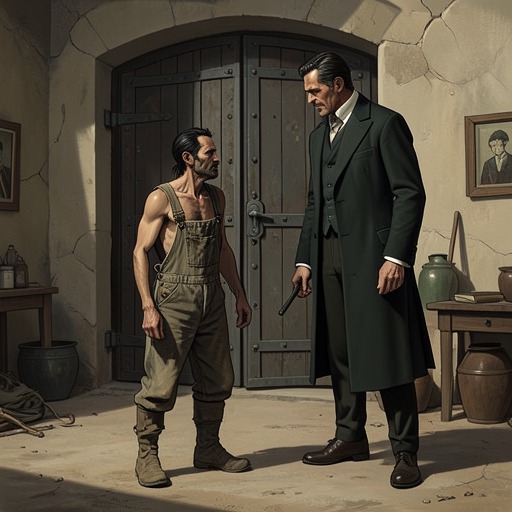
The later account of Clancharlie’s heir encounters another severe face of that legal order. Gwynplaine is brought before Hardquanonne during a formal confrontation concerning the parchment that identifies his birthright. Hardquanonne has already been subjected to peine forte et dure after refusing to answer. The narrative also identifies Southwark Jail as one of the prisons whose chambers had served as torture chambers. These proceedings are not the same event as Clancharlie’s exile, but they show the coercive conditions under which evidence of the dispossessed family’s identity and inheritance finally comes forward.
The inheritance and its aftermath
Clancharlie’s dispossession outlasts his own exile through the danger to his son’s succession. The account of Gwynplaine’s birthright states that he was the only legitimate son of Linnæus, Lord Clancharlie and Ann Bradshaw, and the inheritor of his father’s estates and titles. It further states that King James II ordered the child sold after the peer’s death, with the stated purpose of removing him because of that inheritance. The attack on the child therefore extends the earlier removal of the father: the estates have been sequestrated, and the heir is concealed and kept from the position that would allow him to claim them.
The later confrontation over Hardquanonne’s bottle and its enclosed parchment reverses that concealment. Under the sheriff’s questioning, Hardquanonne is reminded that the parchment contained the declaration and confession of his accomplices, and that the child abandoned on 29 January 1690 has been brought before him. His recognition of Gwynplaine supplies testimony connecting the injured claimant to the inheritance. Clancharlie’s exile and confiscation consequently serve as the political prehistory of a succession dispute: the lost property, hidden heir, and delayed proof of identity belong to one continuing struggle over who may possess the family name and estate.